
Future
Robots Can Now Feel Touch: The Electronic Skin Changing Humanoid Robotics
Large-area electronic skin gives machines pressure, shear, slip and proximity sensing — here is what 2026 research actually proved, and what it did not.
· 8 min · Hangar Works
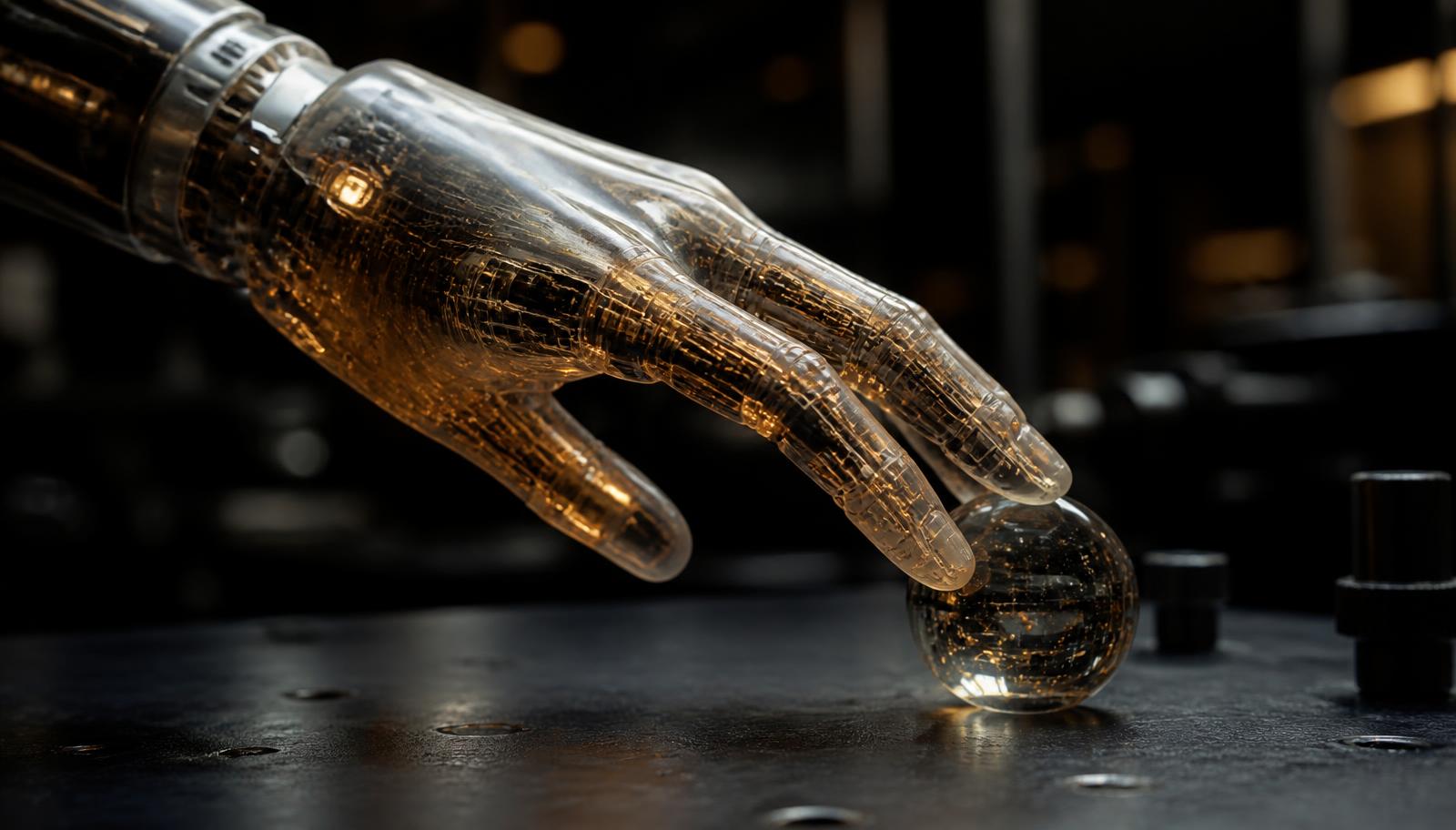
For most of the history of robotics, machines have been effectively numb. A modern industrial arm can repeat a weld to a fraction of a millimetre, and a humanoid prototype can walk across gravel, but almost all of that competence comes from vision, joint encoders and force readings taken at the wrist or the motor — not from the surface that actually meets the world. Ask that same robot to pick up a paper cup, and it either crushes it or drops it, because it cannot feel the moment the cup begins to slip.
That gap is the reason electronic skin — "e-skin" — has become one of the most closely watched areas in robotics. In 2026 the field crossed an important threshold: not human-level touch, but large-area, multi-signal tactile sensing that can be manufactured without exotic facilities and wrapped around real hardware. This is what that actually means, what it can and cannot do yet, and where it is heading.
Why touch matters more than it sounds
Human manipulation is mostly a closed loop built on skin. When you lift a glass, thousands of mechanoreceptors report pressure, stretch, vibration and micro-slip, and your grip tightens before you consciously notice anything moving. Vision plays a supporting role; you can do it with your eyes shut.
Robots have been trying to do the same job with the wrong senses. Cameras fail exactly when contact begins, because the hand occludes the object. Joint-torque estimates are too coarse to detect a few grams of shear at a fingertip. So engineers compensate with rigid grippers, fixtures, and objects that always arrive in the same place — which is why factory automation works beautifully in a cell and badly in a kitchen.
Tactile sensing changes the economics of that problem. A robot that can feel contact can work with objects it has never seen, in positions it was not programmed for, without needing every scene to be visually perfect.
How electronic skin actually works
E-skin is not one technology. It is a family of thin, flexible sensor arrays laminated onto a robot's surface, differing mainly in how they turn deformation into a signal.
Capacitive sensing
The most common approach. Two conductive layers are separated by a compressible dielectric; pressing the surface changes the distance between them and therefore the capacitance. Capacitive designs are sensitive, low-power, and — importantly — can also sense a nearby object before contact, because an approaching hand or metal part disturbs the electric field.
Resistive and quantum-tunnelling sensing
Here, force changes electrical resistance. Quantum-tunnelling composites are a notable variant: a polymer loaded with conductive particles that is an insulator at rest, but whose resistance falls sharply as pressure pushes particles close enough for electrons to tunnel between them. The response is fast and works in very thin layers.
Piezoelectric and optical sensing
Piezoelectric materials generate charge under dynamic load, which makes them excellent at detecting vibration and the tiny high-frequency judder that precedes a slip. Optical approaches instead film a deformable membrane from the inside and infer contact geometry from how it distorts — extremely rich data, at the cost of bulk.
Pressure, shear, slip and proximity
Useful touch requires more than "how hard".
- Pressure — normal force into the surface. This tells the robot that contact happened and roughly how firm it is.
- Shear — force sideways across the skin. This is the signal that says an object is being dragged, twisted, or pulled out of the hand, and it is far harder to measure than pressure because it requires the sensor to resolve direction.
- Slip — the onset of relative motion, usually detected as a characteristic vibration or a rapid change in shear before macroscopic movement occurs. Detect it fast enough and the robot can tighten its grip instead of dropping the object.
- Proximity — pre-contact awareness. A skin that senses an object a centimetre away lets a robot decelerate before impact, which matters enormously when the object is a person.
A skin that reports all four, across a large area, is what researchers mean by "multimodal" tactile sensing.
Where the research actually stands in 2026
Two 2026 papers in npj Flexible Electronics are good markers of the current state of the art, and both are laboratory research rather than shipping product.
The first describes a fish-skin-inspired origami capacitive e-skin covering roughly 60,000 mm² — an area comparable to a robot forearm and hand, which is unusual, since most tactile demonstrations are fingertip-sized. Its folded, scale-like geometry lets a flat sensor sheet conform to curved surfaces without wrinkling or losing calibration. Beyond normal pressure it resolves shear direction and detects objects before contact, and the researchers use machine learning for super-resolution: inferring contact locations finer than the physical spacing of the electrodes, by learning how a single touch spreads its signature across neighbouring elements. That last trick matters, because it means better resolution without more wires.
The second paper attacks the manufacturing problem. It demonstrates cleanroom-free fabrication of multimodal e-skin — production that does not depend on semiconductor-grade facilities — and integrates the result onto a robotic gripper. Scientifically this is less glamorous than a new sensing mechanism, but industrially it is arguably more important: tactile skin that requires a cleanroom will never cover a fleet of robots at an acceptable cost.
On the commercial side, reporting on the Edinburgh-based company Touchlab describes an e-skin thinner than human skin that uses quantum-tunnelling sensing to measure 3D force — magnitude and direction, not just pressure — with slip-related grip adjustments reported in sub-millisecond timeframes. The company has focused on teleoperated robots, including trials with healthcare staff remotely operating a robot to handle objects and interact with patients. That is real deployment in constrained pilots, which is a meaningful step beyond a lab bench — and still a long way from a mass-market product.
The honest summary: large-area, multimodal, manufacturable e-skin exists and works. It is not yet standard equipment on humanoid robots, and none of it constitutes human-equivalent touch.
What it unlocks in practice
Humanoid robots. Legged humanoids currently negotiate the world with vision and balance. Skin adds contact awareness across the whole body — knowing that a shoulder has brushed a doorframe, or that a hand is resting against a wall — which is both a safety feature and a source of stability information that cameras cannot supply.
Factories and logistics. The hardest remaining tasks in warehouses are deformable and irregular items: bagged goods, clothing, produce, mixed-SKU totes. Slip detection converts these from "engineer a custom gripper" problems into general grasping problems. It also reduces damage, which is often the real cost driver.
Healthcare and assistive robotics. Any robot that touches a person needs to know how hard it is pressing, continuously, and to react in milliseconds. Compliant skin with proximity sensing gives a hardware-level safety layer that does not depend on a camera having a clear view.
Delicate and precision manipulation. Laboratory automation, electronics assembly, food handling and repair work all involve objects that fail if gripped wrongly. Touch feedback is what allows force to be regulated rather than merely limited.
It is also worth noting how much of this depends on software. Raw tactile data is a high-rate, noisy stream that only becomes useful once a control policy interprets it — a point that connects directly to the broader shift toward learned control described in our guide to what AI agents are and how they work.
The limitations nobody should skip past
Durability. Skin is the part of a robot that gets abraded, punctured, cut and chemically attacked. Human skin heals; e-skin does not, unless it is designed as a replaceable consumable. Long-duration wear data remains scarce.
Scaling and wiring. Every sensing element ideally needs a connection. Covering a whole humanoid at fingertip density implies an impractical number of wires, so real systems rely on multiplexing, local read-out chips and inference tricks such as super-resolution. Routing all of that through moving joints without fatigue failure is a genuine mechanical problem.
Data volume and latency. Slip response only helps if it is fast. That pushes processing toward the edge — filtering and reacting near the sensor rather than shipping everything to a central computer — which adds power draw and complexity.
Calibration and drift. Flexible materials creep, respond to temperature, and change behaviour after repeated loading. A skin that needs frequent recalibration is a maintenance liability, and self-calibration is an active research area rather than a solved one.
Cost. Cleanroom-free fabrication is a direct attack on this, but a full-body sensing system still competes for budget against simply buying more robots.
What comes next
Expect three developments over the next few years. First, consolidation of manufacturing: fewer exotic materials, more roll-to-roll and printed processes, and skins sold as modular panels with standard connectors. Second, tighter coupling between tactile hardware and learned control, with contact data used directly in training rather than bolted on as a safety interlock. Third, partial coverage strategies — dense sensing on hands, sparser proximity-and-impact skin elsewhere — because full-body fingertip resolution is neither affordable nor necessary.
Touch will not arrive as a single announcement. It will show up as robots that stop dropping things, stop crushing things, and stop needing a perfectly staged environment to be useful. Judged that way, 2026 was a good year.
The bottom line
Electronic skin has moved from fingertip demos to large-area, multimodal, manufacturable systems, with early commercial deployment in teleoperated healthcare and industrial pilots. It gives robots pressure, shear, slip and proximity sensing that vision cannot provide. It does not give them human touch, it is not yet standard on humanoids, and durability, wiring, calibration and cost remain unsolved. But the direction is clear: the next big gains in robot capability will come from the surface inward.
Prefer more machines that shouldn't work? Browse our Future technology and Engineering archives.
Frequently asked questions
- Can robots really feel touch like humans?
- No. Electronic skin gives robots useful tactile signals — pressure, shear, slip and proximity — but it does not reproduce the density, dynamic range or healing ability of human skin, and it does not create sensation.
- What is electronic skin made of?
- Typically a thin flexible polymer carrying an array of sensing elements. Capacitive designs use two conductive layers separated by a compressible dielectric; others use resistive or quantum-tunnelling composites, piezoelectric materials, or optical membranes.
- Do humanoid robots already have electronic skin?
- Not as standard. Large-area multimodal e-skin has been demonstrated in 2026 research and in early commercial pilots such as teleoperated healthcare robots, but most humanoids still rely on vision and joint force sensing.
- Why is slip detection so important?
- Slip is the earliest warning that an object is leaving the grip. Detecting it in milliseconds lets a robot tighten its hold before the object moves, which is what allows safe handling of fragile or deformable items.
Related stories

Space Mirrors: Could Giant Mirrors in Orbit Really Control Earth's Climate?
Could giant mirrors in space control Earth's climate? Explore the science, engineering, costs and risks of space mirrors and solar geoengineering.
8 min read
The U.S. Wants Fusion Power by the Mid-2030s — What Has to Happen First?
The U.S. is targeting commercial fusion deployment by the mid-2030s. Here are the materials, fuel, AI and engineering challenges that must be solved first.
7 min read
Humanoid Robots Are Approaching Their “ChatGPT Moment” — But the Hardest Problems Aren’t What You Think
Humanoid robots can already run and dance. The harder challenge is general-purpose physical intelligence: dexterity, adaptation, data and recovering from mistakes.
8 min read