
Future
Molten Salt Batteries: The Hot Chemistry Behind Next-Generation Energy Storage
A 2026 Nature Reviews Chemistry review makes the case for molten salt electrochemistry — low flammability, cheap materials and unusual ion behaviour. Here is what it could realistically do.
· 9 min · Hangar Works
Almost every battery you have ever used works because ions move through a liquid that would rather not be on fire. Lithium-ion cells use organic solvents that are flammable, temperature-sensitive and expensive to make safe at scale. That single compromise shapes the entire industry: the cooling systems, the fire suppression in grid storage yards, the thermal runaway headlines, the cost of the pack rather than the cell.
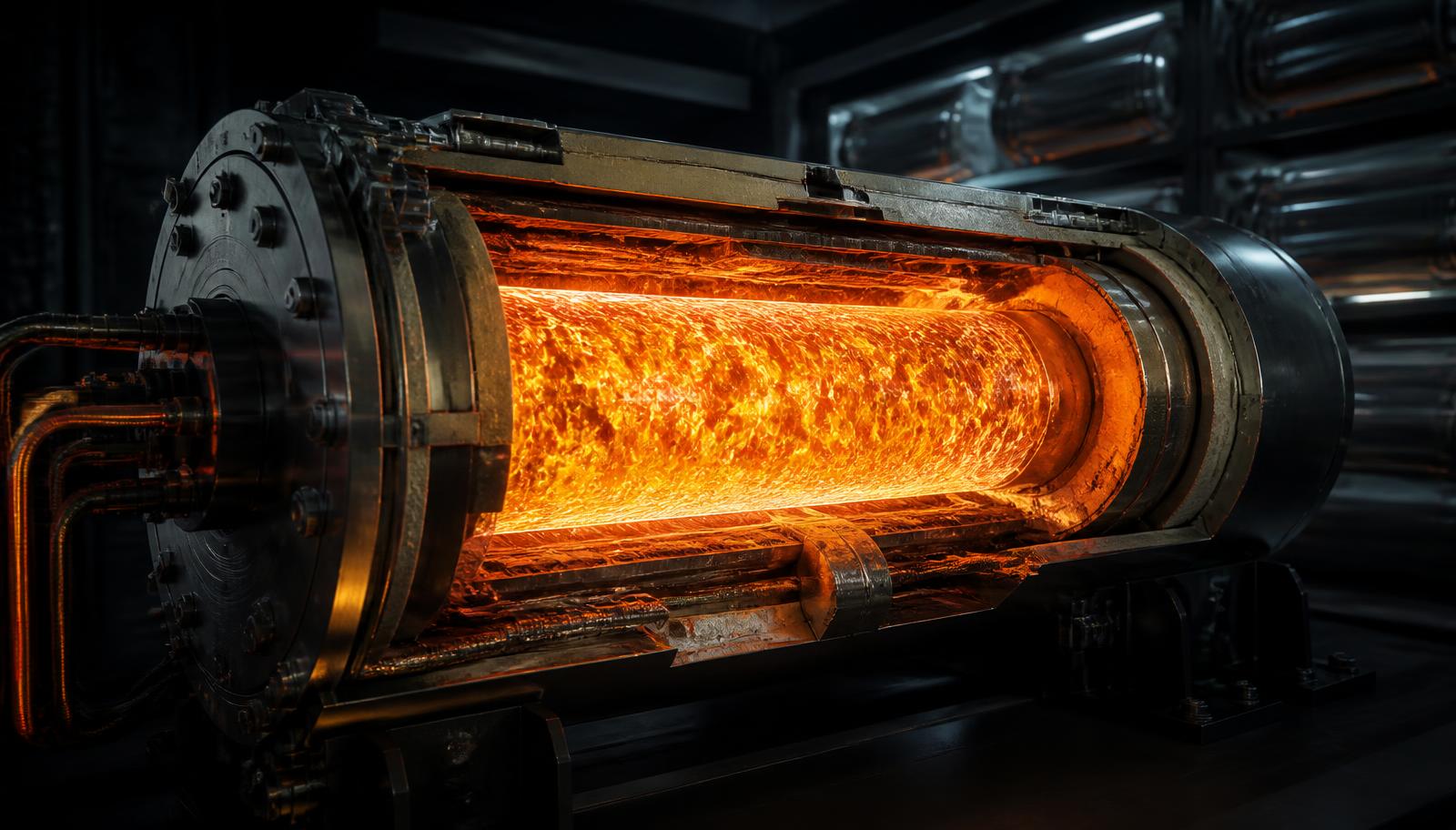
Molten salt electrochemistry starts from the opposite premise. Instead of keeping the electrolyte cool and liquid, you heat an inorganic salt until it melts and use the melt itself as the ion conductor. A review published in Nature Reviews Chemistry on 20 August 2026, "Molten salt electrochemistry for next-generation batteries", pulls this scattered field together and argues it deserves a serious look for the storage jobs lithium-ion does badly.
It is worth being precise about what that claim is and is not. Nothing here suggests molten salt cells are about to appear in a phone or an electric car. They are a candidate for a different set of problems.
What a molten salt electrolyte actually is
At room temperature, common inorganic salts — chlorides, fluorides, carbonates, nitrates and their mixtures — are hard crystalline solids. Heat them past their melting point and they become clear, mobile liquids made almost entirely of ions. There is no solvent in the usual sense: the liquid is the charge carrier.
That structural difference produces a distinctive set of properties.
- Low flammability. Inorganic salts do not burn the way organic carbonate solvents do, which removes the dominant fire pathway in conventional cells.
- High thermal stability. Many of these melts are stable across hundreds of degrees, so heat is an operating condition rather than a failure mode.
- Abundant charge carriers. Ion concentration in a melt is extremely high compared with a dilute salt dissolved in solvent, which supports high conductivity and high current densities.
- Potentially low material cost. The candidate salts are industrial commodities, not specialty chemicals, and several of the electrode chemistries pair with abundant metals.
- Unusual solvation. In a melt, ions are coordinated by other ions rather than by solvent molecules. This changes how strongly a working ion is held, which in turn affects transport, interfacial reactions and how stable the electrode surface stays over many cycles.
That last point is the one chemists find most interesting. Solvation structure is a major lever on kinetics, rate capability and cycling stability, and molten salts offer a design space that liquid-solvent chemistry simply cannot reach.
Three architectures, in plain language
The review groups the practical work into a few families. The distinction is essentially about what, if anything, keeps the two electrodes apart.
Membrane-free cells
The simplest concept. The cell relies on physics rather than a barrier: the electrode materials and the molten electrolyte have different densities, so they self-separate into stacked layers, like oil on water. Liquid metal at the bottom, molten salt in the middle, a second liquid metal or alloy on top.
The advantages are attractive. There is no fragile separator to crack, the interfaces are liquid so they cannot be damaged by repeated charging, and the construction is mechanically simple. The catch is that everything depends on maintaining that stratification, which constrains how the cell can be sized, moved and operated.
Membrane-assisted cells
Here a solid ion-conducting ceramic sits between the electrodes and passes only the working ion. This is a much older idea in engineering terms — sodium-based high-temperature cells have used ceramic separators for decades — and it buys real freedom, because the two sides no longer have to be chemically compatible or density-ordered.
The price is the membrane itself. It must conduct well at operating temperature, resist chemical attack from a hot melt on both faces, survive thermal cycling without cracking, and be manufacturable at low cost in large areas. Those requirements pull against each other, and the membrane is often the component that decides the lifetime of the cell.
Molten salt gas batteries
The newest branch, and the most exploratory. Instead of storing charge in two solid or liquid electrodes, one side uses a gas — oxygen, carbon dioxide or similar — reacting at an electrode in contact with the melt. The molten salt both conducts ions and helps dissolve or activate the gas species.
The appeal is theoretical energy density, since one reactant effectively comes from outside the cell. The reality is that these systems are early-stage laboratory chemistry with substantial questions about reversibility, product management and electrode stability. They belong in the "worth watching" column, not the deployment column.
The problems that have kept this out of the market
None of the difficulties below are secret, and the review is candid about them. They are also the reason molten salt storage has existed as a niche for decades without breaking through.
Operating temperature. Most of these systems run hot — typically well above the boiling point of water, and in some chemistries far above it. Everything downstream of that fact becomes harder.
Corrosion and material compatibility. A hot ionic melt is an aggressive chemical environment. Containers, current collectors, seals and any structural metal must resist attack for years, not weeks. Corrosion is arguably the central engineering problem of the field.
Sealing. Hot cells expand, contract and, in the case of gas chemistries, hold pressure. Seals that survive thousands of thermal cycles without leaking are a genuinely hard component, and a leaked molten salt is a serious industrial hazard even if it is not flammable.
Thermal management and startup energy. The cell must reach operating temperature before it works at all. Getting there costs energy, and a system that sits idle either burns power to stay hot or accepts a slow, expensive restart. Good insulation helps, and large formats help more, because heat loss scales with surface area while capacity scales with volume — which is exactly why this technology suits big installations rather than small ones.
System complexity. A hot battery is not a drop-in module. It carries heaters, insulation, thermal sensors, corrosion-resistant plumbing and a control system that has to keep all of it inside a safe window. Round-trip efficiency and cost must be judged at that system level, not at the cell.
Economics. Cheap salts do not automatically produce a cheap system. The materials bill may be low while the balance-of-plant bill is not, and lithium-ion continues to get cheaper every year. Any challenger is aiming at a moving target.
Where they would actually compete with lithium-ion
The realistic answer is: mostly not in the same places.
Stationary grid storage. This is the natural fit. Grid installations are large, stationary, professionally maintained and operated more or less continuously — which neutralises the startup-energy and insulation penalties. They also care intensely about fire risk, land use and cost per kilowatt-hour over a long life, all areas where a non-flammable, cheap-material chemistry has a real argument. Long-duration storage, where you need many hours of energy rather than fast bursts, is the sharpest version of that case.
Extreme-temperature and industrial niches. Any setting that is already hot — steelworks, concentrated solar plants, industrial process heat, some downhole and aerospace applications — inverts the usual objection. Waste heat that a conventional battery would need protecting from is, for a molten salt cell, free operating temperature.
Where they will not compete. Phones, laptops, wearables and passenger EVs are essentially closed to this chemistry. Those applications need cold-start capability, small form factors, high gravimetric energy density and safety in the hands of untrained users. A cell that must be held at several hundred degrees fails all four tests. Lithium-ion, and the solid-state variants being developed alongside it, remain the technologies for those jobs.
The useful mental model is not replacement but division of labour: light, cold, portable storage on one side; heavy, hot, stationary storage on the other.
What happens next
Progress in this field will be visible in three places. First, materials: better corrosion-resistant containment and cheaper, tougher ceramic membranes would move more than any new electrode couple. Second, temperature: chemistries that operate lower — closer to a few hundred degrees than a thousand — shrink almost every engineering problem at once. Third, demonstration scale: multi-year field data from real installations, showing measured round-trip efficiency, degradation and maintenance cost, is what separates a promising review from a bankable technology.
A 2026 review article is a signpost, not a product announcement. It says the chemistry is well enough understood and the potential large enough that the remaining work is mainly engineering. That is a genuinely encouraging position — and it is still years of unglamorous corrosion testing away from anything you could buy.
The bottom line
Molten salt electrochemistry offers non-flammable, thermally stable, potentially cheap electrolytes with high carrier concentrations and unusual ion solvation that can benefit kinetics and cycling. Membrane-free, membrane-assisted and gas-based architectures each trade simplicity against flexibility, with gas systems the least mature. The blockers are heat, corrosion, sealing, complexity and cost — engineering problems, but stubborn ones. If molten salt batteries matter, it will be on the grid and in hot industrial settings, not in your pocket.
More from the hangar: browse our Future technology and Engineering archives, or read how electronic skin is changing humanoid robotics.
Frequently asked questions
- What is a molten salt battery?
- A battery that uses an inorganic salt, melted into a liquid at high temperature, as its electrolyte. The melt is made almost entirely of ions, so it conducts charge without the flammable organic solvents used in lithium-ion cells.
- Are molten salt batteries safer than lithium-ion?
- They remove the main fire pathway, because inorganic salts are not flammable the way organic solvents are. They introduce different hazards instead: high operating temperatures, hot corrosive liquid and the consequences of a seal failure.
- Will molten salt batteries replace lithium-ion in phones and electric cars?
- No. They need to be held at high temperature to work at all, which rules out small, portable, cold-start applications. Lithium-ion and solid-state variants remain the technologies for consumer electronics and passenger EVs.
- What are they actually good for?
- Large stationary installations — grid and long-duration storage — and industrial settings that are already hot, such as steelworks or concentrated solar plants, where the heating requirement is not a penalty.
- Are they commercially available today?
- High-temperature sodium-based cells have existed in niche use for years, but the broader molten salt concepts covered in the 2026 Nature Reviews Chemistry review are research-stage. Corrosion, sealing, membranes and system economics still need to be solved before wide deployment.
Related stories

Space Mirrors: Could Giant Mirrors in Orbit Really Control Earth's Climate?
Could giant mirrors in space control Earth's climate? Explore the science, engineering, costs and risks of space mirrors and solar geoengineering.
8 min read
The U.S. Wants Fusion Power by the Mid-2030s — What Has to Happen First?
The U.S. is targeting commercial fusion deployment by the mid-2030s. Here are the materials, fuel, AI and engineering challenges that must be solved first.
7 min read
Humanoid Robots Are Approaching Their “ChatGPT Moment” — But the Hardest Problems Aren’t What You Think
Humanoid robots can already run and dance. The harder challenge is general-purpose physical intelligence: dexterity, adaptation, data and recovering from mistakes.
8 min read